
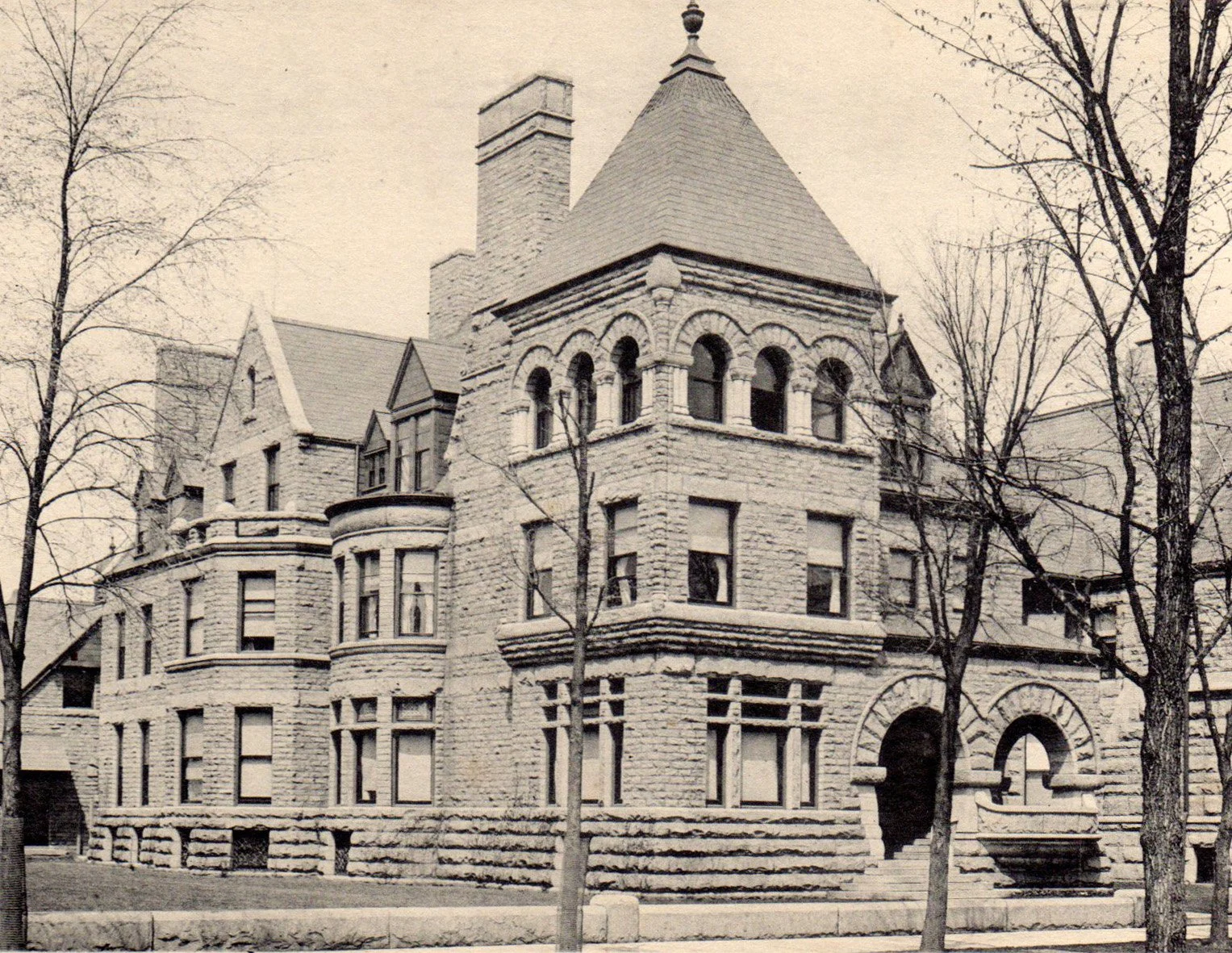
A. C. Bartlett house, 2720 South Prairie Avenue, Chicago. The house was designed by the firm of Cobb & Frost, comprised of architects Henry Ives Cobb and Charles Sumner Frost, and was completed in 1886. Cobb was regarded as the best local interpreter of the Richardsonian Romanesque style, as evidenced by the heavy rusticated stone, the massive arches forming the recessed porch at right, and the arcade of windows on the third floor of the corner tower.
Adolphus Clay Bartlett (1844-1922) came to Chicago in 1863 to work for a hardware company, becoming a partner in 1877, at which time it was renamed Hibbard, Spencer, Bartlett & Co.; he later served as president. Bartlett was a founding trustee of the Chicago Symphony Orchestra, a director of the Art Institute of Chicago, and a trustee of the University of Chicago, where he donated the funds to construct the Bartlett Gymnasium in 1901.
Bartlett moved out of his Prairie Avenue home in the late 1910s, after which it was converted to the Almena Parker McDonald Sanitarium (later the Magnus Sanitarium). In 1938, the building became a WPA household training center and was equipped with four kitchens, a laboratory kitchen, six bedrooms, and the machines, utilities, and appliances used in homes. The center provided facilities for the instruction of 150 to 200 Black women at a time in all phases of domestic activity, with training sessions lasting two months. First Lady Eleanor Roosevelt visited the center in May 1941 when she came to Chicago to dedicated the nearby South Side Community Art Center.
The house was demolished in the late 1950s when most of “lower” Prairie Avenue was cleared in the name of urban renewal. Chicago artist Jack Simmerling visited the house prior to demolition, and wrote about the interior in his book, Chicago’s Old Houses, Lore and Legend:
“Its interior changed little over the decades. Before its demolition, great jewel-like green and opalescent white leaded glass windows formed light patterns on the massive staircase of ebonized wood and grillwork of wrought iron. Built-in floor-to-ceiling mirrors framed in carved mahogany had not yet been defaced by vandals. Elaborate Byzantine designs stenciled on tooled leather still covered the dining room walls and ceiling. A fireplace in the dining room was faced with gold iridescent glass. The effect was to reflect wealth at every turn . . . “