
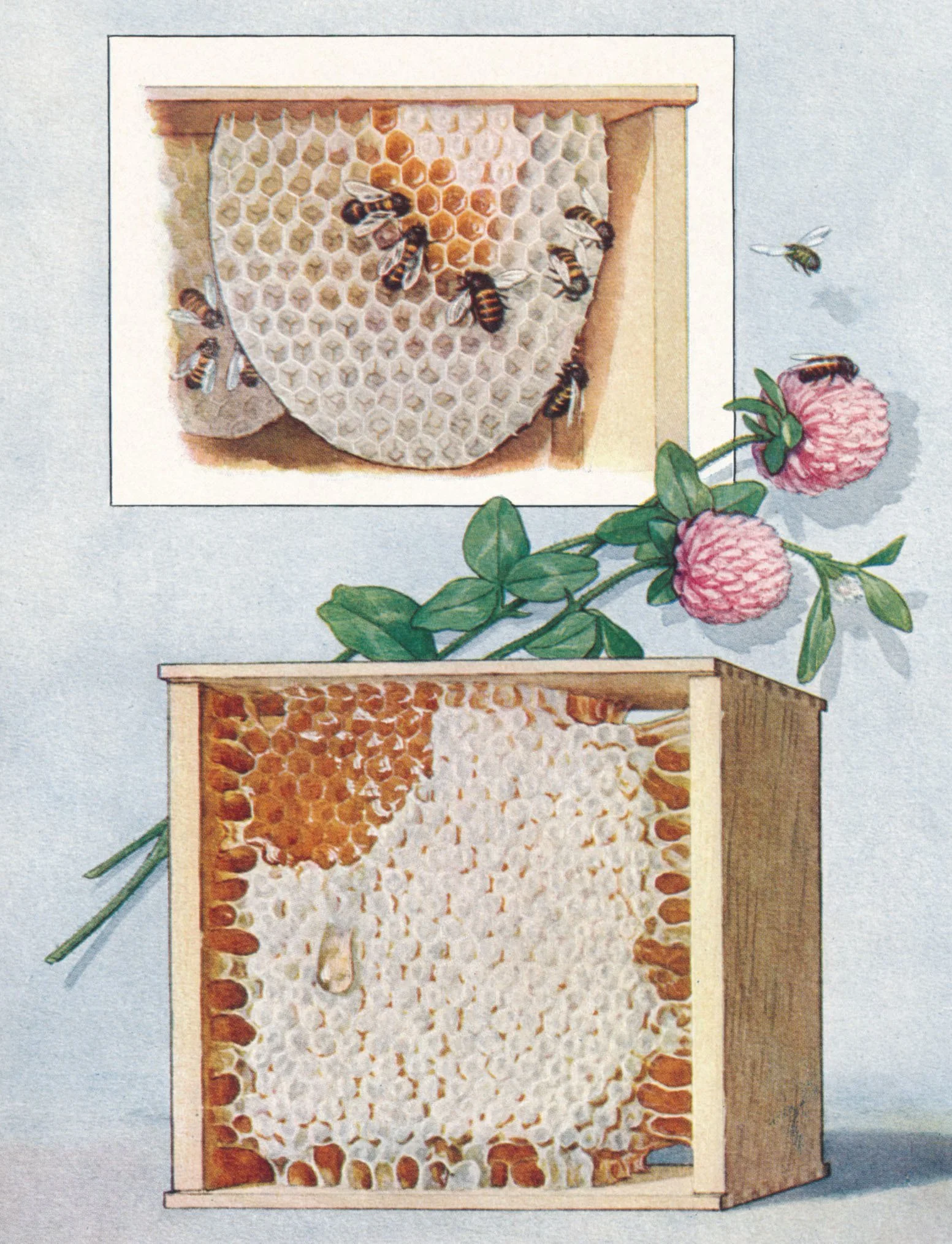
“Honey” from The Grocer’s Encyclopedia, edited by Artemas Ward, published 1911. This 748-page volume, costing $10.00 (about $350.00 in 2026), provided detailed information and extensive illustrations on every type of food and beverage available at the time.
The section on honey includes three pages of information describing exactly how honey is produced by bees, the types of honey available, how it should be stored, and the various flavors, depending on the flowers from which the honey is extracted by the bees. A few interesting notes:
Honey is the sucrose secreted by the glands of flowers, extracted by the proboscides of the working bees and inverted in their crops or honey bags into Invert Sugar or Dextrose and Levulose sugars. At the hive, the bee disgorges his burden into the cells of the comb as a reserve supply of food for the colony. As thus at first deposited the honey is a thin liquid—it attains its later syrupy consistence by evaporation.
A hive of fifty to seventy-five thousand bees will yield an average of about one pound of honey daily during the season, the quantity rising to two to three pounds a day at the height of the season. If left to their own devices, the bees begin their annual work by building the combs, the process taking about half their time.
Comb Honey is that straight from the hives. The bees not only make the honey we eat, but also put it up in packages for us!
Strained Honey is that extracted from the combs, generally by centrifugal process—the rapid revolving of the combs inside mesh-cylinders causing the honey to exude.
Candied Honey, as marketed, is strained honey evaporated to solidity. It is a confection classed with Maple Sugar, etc.
The flavors of honey before blending vary as much as, or more than, those of fruits. Mountain Sage is very mild; Buckwheat is so strong as to be almost biting to the palate; Basswood has a pronounced mint taste; White Clover is milder than Basswood and stronger than Mountain Sage; Alfalfa resembles White Clover.