
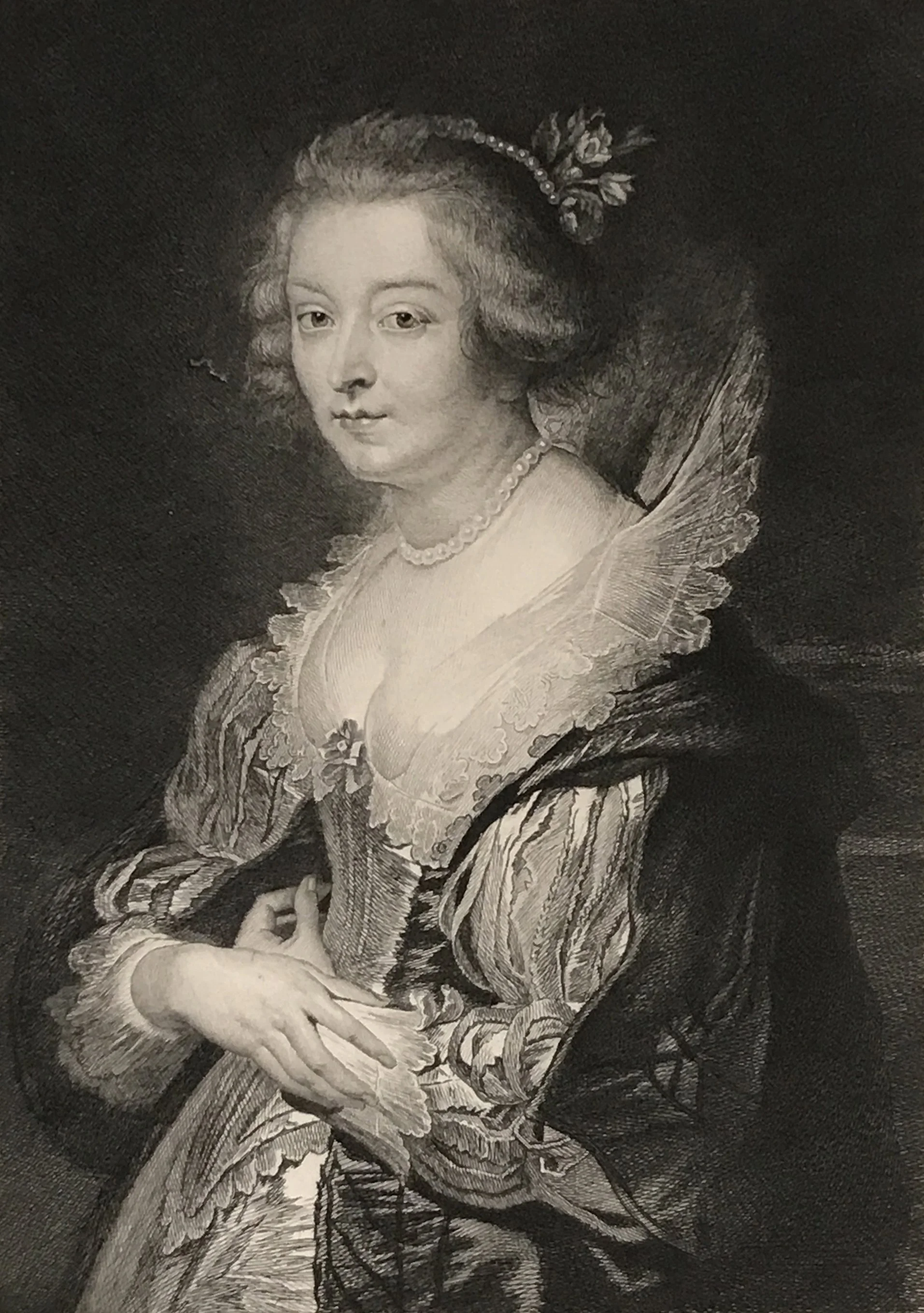
Engraving of “Portrait of a Woman,” based on a painting by the Flemish Baroque artist Peter Paul Rubens (1577-1640). The Glessners purchased the engraving and a self-portrait of Rubens as a pair in December 1879, believing they depicted Rubens and his wife, but the story gets complicated.
The original oil on panel painting, created circa 1625 to 1630 and now in the Royal Collection, is known simply as “Portrait of a Woman,” as the identity of the woman is not conclusively known. When King George IV acquired the painting in the 1820s, he believed it to be the portrait of Rubens’s second wife, Helena Fourment. A number of different engravings were made from the painting in the 19th century, and surviving copies in museum collections identify it as the portrait of either Rubens’s first wife, Isabella Brant, or his second wife, Helena. The online Royal Collection listing notes that the informal style of the painting would indicate it was a portrait of a member of Rubens’s extended family, but that it “does not seem to depict Helena, whose features are well recorded in other images, but the name of another Fourment sister, Elizabeth (born 1606), has been suggested.”
The engraving was created by the French artist Leopold Flameng (1831-1911), and was printed by Thomas McLean and P. & D. Colnaghi & Co. of London in 1877. The Glessners paid $36 for the pair of engravings (the equivalent of about $1,200 in 2026), and commissioned Isaac Scott to craft a magnificent double frame, which is displayed in the second floor hall.